High-density polyethylene is encountered by many people in everyday life, as milk bottles, water pipes, or industrial containers. In boat building, the material is less well known, but technically well established. In this article, we put into perspective what the material properties mean concretely for a sport boat: factually, with reference to applicable standards, and without marketing promises.
What is HDPE? A uniform definition
HDPE (short for High Density Polyethylene, in English also frequently called high-density polyethylene or rigid polyethylene) is a thermoplastic with predominantly linear molecular structure and low branching. The designation and specification basis is defined in ISO 1872-1 [2]. Within the polyethylene family, the standard distinguishes types among other things by density and melt flow rate, which in turn affects mechanical and thermal properties [5].
The typical density of HDPE is approximately 0.941–0.97 g/cm³ — for polyethylene a comparatively high value, significantly above that of LDPE (Low Density Polyethylene) [4]. This gives rise to the first relevant boat-building aspect: HDPE is not denser than pure fresh water: it floats without buoyancy bodies. The actual floating position of a finished boat is more complex and is determined according to the EN ISO 12217 standard (more on this below).
Material properties that matter in boat building
For use in a sport boat, five properties are particularly relevant. We list them plainly: ranges rather than point values, because values vary depending on type and manufacturer.
- Impact resistance: HDPE absorbs impacts elastically rather than dissipating them through cracks. Bumping against a dock or light grounding typically result in dents, not visible breaks. Fiber-reinforced composites do not behave this way, and we deepen the comparison perspective in the pillar article „HDPE vs GFK Boat”.
- Corrosion behavior: HDPE is chemically very resistant to salt water, many acids, and alkalis. Galvanic corrosion (as with metal hulls) is not an issue with the polymer.
- Water absorption: HDPE absorbs very little water. This stabilizes weight and behavior throughout the season.
- UV behavior: Pure polyethylene becomes brittle under UV radiation over longer periods. For outdoor use, stabilizers such as carbon black or special UV additives are therefore incorporated, which significantly increase lifespan [6]. Care—particularly storage in the shade or under a tarpaulin—further reduces UV load. What this looks like in practice, we describe in the article „HDPE boat maintenance and winterization”.
- Repairability: Damaged areas can in many cases be restored on the thermoplastic by welding. This is process-technically demanding and belongs in expert hands; conceptually, however, the repair path is uniform, which positively affects recyclability.
Stay terminologically precise: Statements like „HDPE is unsinkable“ or „maintenance-free“ do not withstand scrutiny. Correct is: HDPE boats are designed with buoyancy measures that are evaluated according to EN ISO 12217, and they are low-maintenance, not maintenance-free.
When an HDPE hull is certifiable
In the European Union, the Directive 2013/53/EU (short RCD, Recreational Craft Directive) applies to recreational craft with hull lengths between 2.5 and 24 m. It defines conformity requirements for placing on the market [1]. Material issues are not rigidly prescribed in this; what is decisive are the proven properties of the finished boat.
This is concretely framed by two harmonized standards:
- EN ISO 12215 defines requirements for hull construction and dimensioning (in particular Part 5 on design pressures and material stresses).
- EN ISO 12217 defines the assessment of stability and buoyancy and classifies the boat into a design category A, B, C, or D [3].
The design categories are defined by wind and wave limits [7]:
| Category | Intended conditions | | --- | --- | | A Ocean | Wind force over 8 Beaufort, significant wave height over 4 m | | B Offshore | Wind up to and including 8 Beaufort, waves up to 4 m | | C Coastal waters | Wind up to and including 6 Beaufort, waves up to 2 m | | D Protected waters | Wind up to and including 4 Beaufort, waves up to 0.3 m (occasionally up to 0.5 m) |
Important: The category is a design statement, not a blanket permit for any conditions. It states what the boat was designed for; nautical responsibility remains with the person on board.
What manufacturers state about the SeaStorm 17
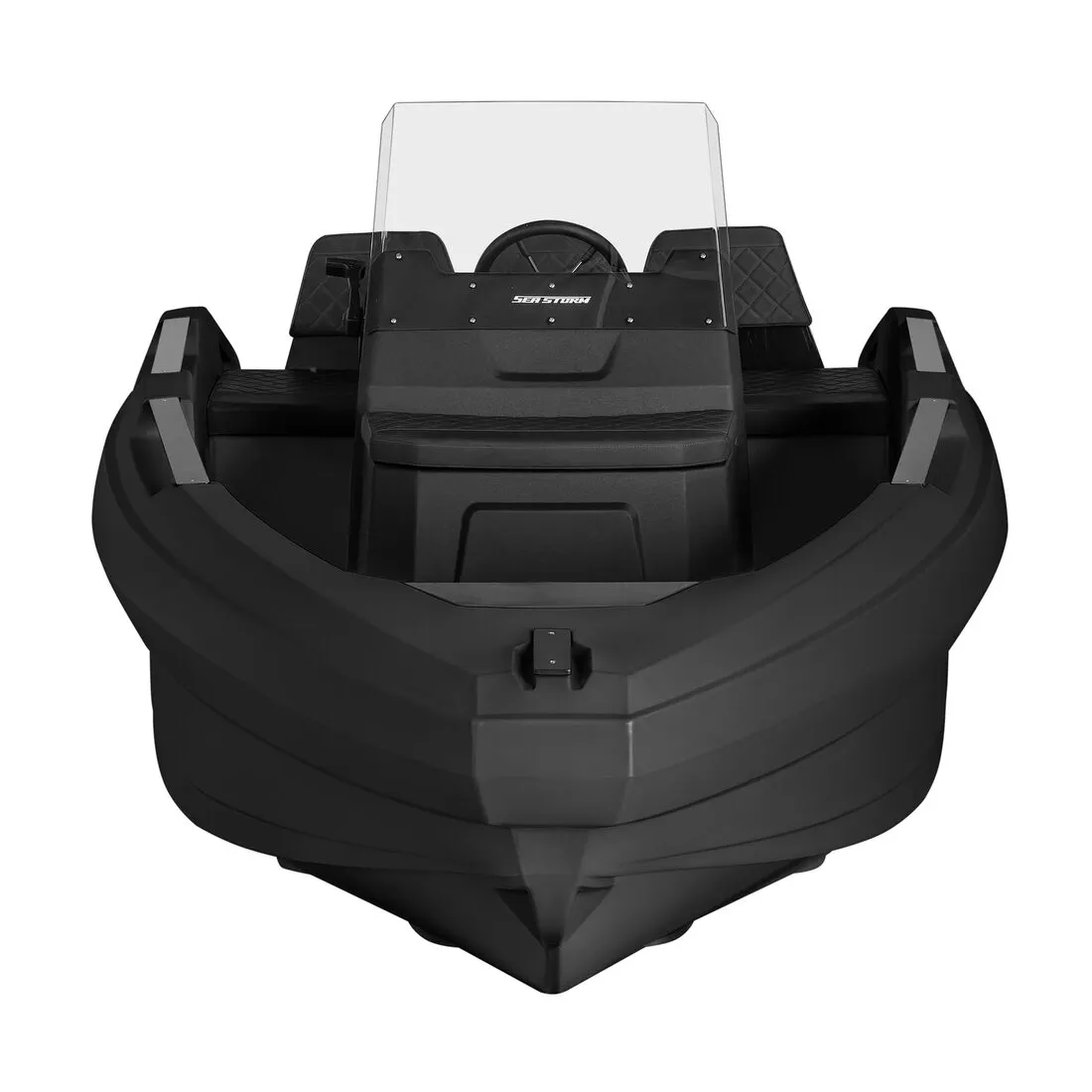
To keep it concrete, a look at the boat we distribute. The following information is manufacturer/distributor information and may change due to model updates:
- Hull length: 5.17 m (within the scope of RCD)
- Hull weight: approximately 380 kg
- CE compliance: Design categories C and D
- Shell construction: double-wall HDPE construction
- Motorization: typically 40–80 PS outboard motor
For an individual application, such as specifically „Can I use it on this lake / this bay?“, it always depends on the combination of category, local conditions, loading, and competence. This overview does not replace that.
Limits and duties, honestly named
HDPE is a good material for many applications, but it is not magical. Three points we routinely address:
- Maintenance effort remains: Cleaning, drying, UV-protective storage are part of it. We go into detail on this in the article „HDPE boat maintenance and winterization”.
- Observe licensing requirements: In Germany, internal combustion engine boats over 11.03 kW (15 PS) require a license for recreational boating on most waterways. Requirements vary depending on the area.
- Category is design, not guarantee: The design category states what conditions the boat was designed for. Your own experience, weather conditions, and loading must fit; this is nautical diligence, not a boat building promise.
If you take specific questions about the SeaStorm 17 from this article—from hull construction to categorization—write to us. We respond in text and without sales pressure.