
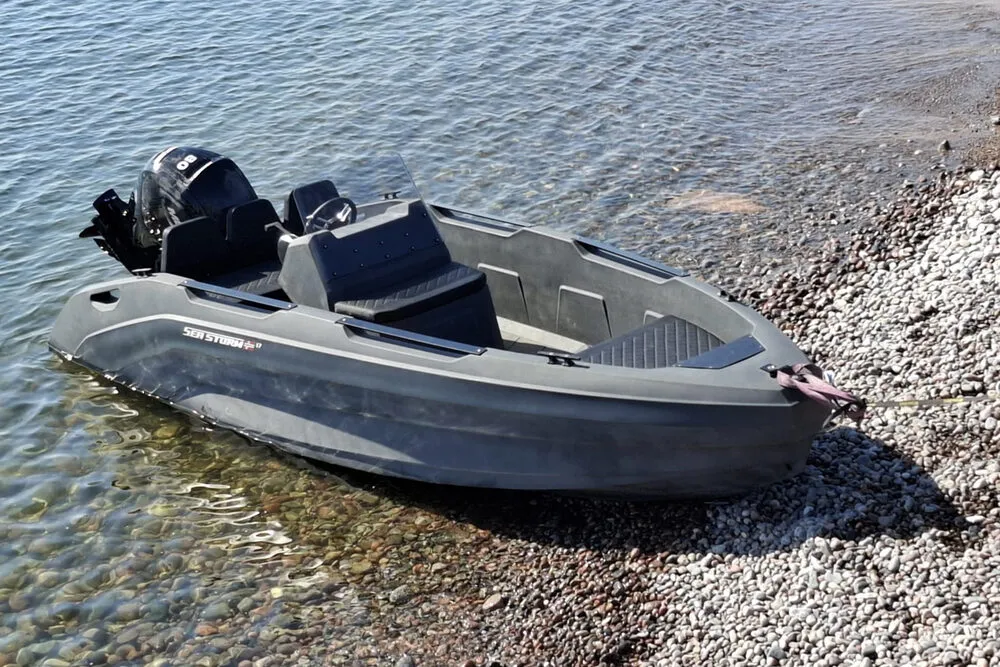
HDPE boats are considered low-maintenance, and they are, compared to many other materials. But „low-maintenance“ is not „maintenance-free“. Below is what has proven effective from our experience and manufacturer recommendations around polyethylene hulls.
Why HDPE requires less maintenance, and what still needs to be done
Polyethylene is chemically resistant to salt, fresh water and many cleaners. It absorbs almost no water and has good impact resistance. This saves a lot of effort that applies to other materials: no osmosis inspections on the polymer, no gelcoat maintenance, no corrosion-prone metal surfaces on the hull itself.
But you do need to care for: cleaning, UV protection, seals, outboard motor service, fuel lines and all components not made from HDPE (fittings, upholstery, electrics). Much of this is standard boat care rather than HDPE-specific, but needs regular attention.
Clarification: Claims like „HDPE boats are maintenance-free“ do not withstand critical scrutiny and are problematic from a consumer law perspective. We intentionally say „low-maintenance“.
Cleaning during the season
A rule of thumb: rinse with fresh water after every saltwater outing, visual check after every extended day. In more detail:
- Cleaners: pH-neutral to weakly alkaline boat cleaners are unproblematic. Avoid bleach, acetone or aggressive solvents, they attack seals, decals and upholstery more than the HDPE shell itself.
- High pressure: use moderately. Keep distance, choose a wide nozzle angle. Fittings, threaded connections, seals and decals are more sensitive than the hull.
- Outboard motor flush: after saltwater or brackish water use the manufacturer’s flush muff and run the motor until clear water comes out.
- Upholstery and fabric parts: remove or let dry. Mold on textile components is a more frequent problem than material fatigue on the hull.
UV protection and preventing discoloration
Boat-building HDPE is equipped with UV stabilizers (often carbon black / soot or equivalent light stabilizers) [1] [2]. Nevertheless, every polymer material ages under prolonged UV exposure. Discoloration or graying over years is possible, but can be delayed through maintenance:
- Prefer shade: covered mooring berth, carport or hall storage during winterization significantly extend the lifespan of components outside the shell (upholstery, decals, hoses).
- Tarp with ventilation: breathable, form-stable, padded at pressure points. Complete sealing creates condensation, which promotes mold.
- Lightening: with colored hulls, lightening can occur over the years, this is not a defect in shell strength, but a surface effect. Polish products specifically for polyethylene can help depending on manufacturer recommendations.
Winterization step by step
Frost itself poses no challenge to the HDPE shell. Unlike GFK boats, there is no gelcoat that can develop micro-cracks in temperature fluctuations. Critical are all components where water can collect. A routine that has proven effective:
| Step | Frequency | DIY or shipyard | | --- | --- | --- | | Exterior cleaning (hull, superstructure) | Season end | DIY | | Interior drying, store upholstery | Season end | DIY | | Outboard motor conservation (flush, carburetor/tank, antifreeze) | Season end | DIY with routine or shipyard | | Tank and fuel system check | Season end | Shipyard recommended | | Fittings and fasteners check for tightness | Season end | DIY | | Trailer tires check, pressure adjust | Season end | DIY | | Storage (hall, covered, tarped) | Season end | if possible | | Season start check | Season start | DIY + possibly shipyard (motor) |
Anyone who has not yet done outboard motor maintenance themselves should not improvise for the first time before winter storage; the manufacturer’s manual for the motor is binding here, a specialist workshop the safe choice.
Small repairs vs. shipyard work
HDPE is a thermoplastic and in principle weldable (hot air, extruder). This is not a standard DIY task: correctly executed welding seams require suitable equipment, the correct welding rod material in the right type, and experience with temperature control. A poorly executed seam can reduce structural strength.
Clear boundary: Surface cleaning, fastener securing, cleaning the outboard motor flush water connection can be handled in-house by most boat owners. Structural repairs to the hull, outboard motor or fuel line are shipyard work. Safety on the water starts with honestly acknowledging your own limits.
What we don’t promise, and what we’re happy to do
What you will not read here: blanket lifespan guarantees or the claim that „proper care rules out every problem“. Both would be irresponsible. What we do when you write to us: answer concrete questions about cleaners, winterization strategies or shipyard appointments for the SeaStorm 17 with our practical experience.
For more about the material itself, start with “HDPE boats: what polyethylene delivers as a boat material”. For comparison between HDPE and GFK, the pillar article “HDPE vs GFK boat” provides the detailed comparison.