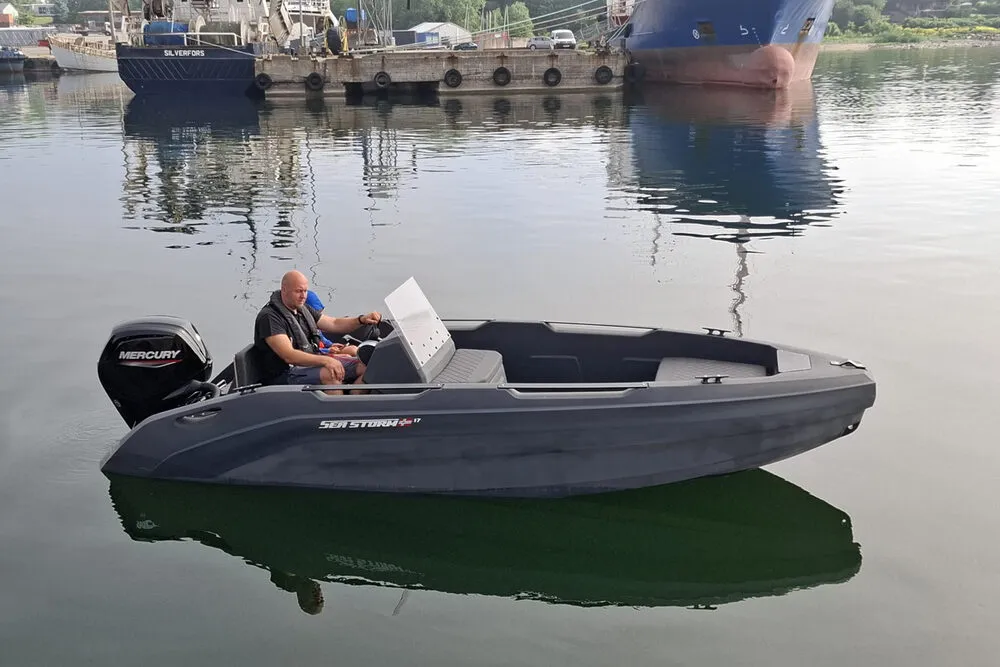
When buying a sports boat, sooner or later you encounter the material question: high-density polyethylene (HDPE) or glass-fibre reinforced plastic (GFK)? Both are established in boat building. Both have advantages and disadvantages. This article lays them out objectively side by side, with sources, in ranges, and without any claim to conduct „advertising“ in either direction.
What this is about, and what it is not
We write this article as suppliers of an HDPE boat (SeaStorm 17), but we respect the rules on comparative advertising under §6 UWG: We compare objectively and factually, exclusively verifiable and relevant properties, and we do not disparage competitors. This is also in our own interest: GFK boats are a broad field of quality manufacturers, against whom blanket denigration would be neither fair nor sustainable.
What we do not claim: that HDPE is „better.“ We show what it is better suited for, and for which profiles GFK remains the obvious choice.
Material basics in brief
HDPE (high-density polyethylene) is a thermoplastic with linear molecular structure and low branching. The material specification is regulated in ISO 1872-1 [4]. Boatbuilding HDPE is typically UV-stabilized (e.g. with carbon black), which significantly improves weather resistance compared to pure PE. Density is around 0.941–0.97 g/cm³. An in-depth look at the material can be found in our fundamentals article “HDPE Boats: What Polyethylene Delivers as a Boat Material”.
GFK (glass-fibre reinforced plastic, GRP in English) consists of glass fibres embedded in a resin matrix (often polyester or vinyl ester resin). The material is created in multiple layers (laminate) on a mould. GFK has been the standard in boat building for decades and shapes the image of „yacht“ for most buyers. Design and dimensioning of recreational boats, regardless of material, is regulated in EN ISO 12215; stability and buoyancy assessment with the associated design category A to D under EU Directive 2013/53/EU follows EN ISO 12217 [1] [2] [3].
Material comparison at a glance
The following table sets out key properties side by side. We work with ranges, because „the one HDPE“ or „the one GFK“ does not exist – material variants, wall thicknesses, and construction make the difference.
| Property | HDPE | GFK | | --- | --- | --- | | Density (material) | approx. 0.94–0.97 g/cm³ [4] | approx. 1.4–2.0 g/cm³ (laminate, depending on fibre content) | | Impact resistance | High; impacts typically cause dents rather than cracks | Moderate; impacts can cause spider cracks or delamination | | Corrosion behaviour | Excellent resistance to salt water, fresh water, acids/alkalis | Excellent; osmosis phenomena possible if gelcoat is damaged | | UV resistance | Good with stabilizers (e.g. carbon black) | Good via gelcoat layer, yellowing possible over years | | Repair | Welding (hot air/extrusion) by specialist | Laminate repair with resin and glass fabric | | Recycling if sorted | Mechanical recycling established (in packaging sector) [10] | Demanding; currently no comprehensive solution in Germany [7] [8] | | Design variety | Limited, typically double-wall shells, compact forms | Very high, almost any shape manufacturable, multi-part constructions | | Design culture | Functional, robust, no-frills | Established, high-gloss; variety from sports boat to yacht | | Lifespan range | With proper maintenance typically several decades | With proper maintenance typically several decades |
Note on interpretation: Ranges serve honest orientation. They replace no detailed assessment of a specific model. Point values („exactly X kg per m²“) are found in the datasheets of the respective manufacturers and in the compliance documentation under RCD 2013/53/EU.
Practice: What does this mean in the harbour?
Material data explains the theory. The actual difference often becomes tangible at the dock, the pier, and on the trailer:
- Docking at a rough pier: HDPE shells generally handle minor bumps better. With GFK, gelcoat cracks can occur, which long-term can contribute to osmosis susceptibility, avoidable with fender discipline and maintenance.
- Trailering and crane loading/unloading: Lower hull weight makes trailering easier and reduces towing vehicle requirements. HDPE boats in the class we are considering typically weigh several hundred kilograms hull weight; GFK boats in the same class can be significantly heavier, depending on laminate thickness.
- Salt water / fresh water: Both materials are salt-water suitable, but GFK boats benefit more from timely cleaning after salt contact, because microscopic gelcoat defects can accelerate corrosion effects. Again: good maintenance makes both materials durable.
- Outdoor mooring: UV exposure affects both materials. Tarpaulin, covered mooring or shaded storage extend the lifespan of both; there is no fundamental „maintenance-free“ option for either.
More on the maintenance side, specifically for HDPE boats, can be found in our article “Maintain and winterize an HDPE boat”.
Costs: what can be reliably compared
The most honest answer to „what does what cost?“ is: it depends on the specific model. Still, we outline a few reliable ranges, without naming competing manufacturers, which under §6 UWG would anyway be only conditionally permitted.
- Purchase: sports boat up to 17 feet (HDPE): typically approx. 15,000–30,000 EUR, depending on engine, hull configuration, and equipment. As an example, our SeaStorm 17 starts at 19.999 EUR with a 40 PS engine; depending on configuration, correspondingly more.
- Purchase: GFK boat in the same class: market range overlaps with HDPE range. Material cost is only one factor; established brand names, shipyard quality, and equipment packages determine the final price more strongly.
- Maintenance during operation: cleaning, seasonal opening/closing, outboard maintenance are necessary for both materials; the scale of annual outlays depends more on size, engine class, and mooring location than on hull material.
- Repair costs after damage: here the concepts diverge. HDPE welding is a different skilled trade from laminate repair, both have their specialists. Blanket figures would be unreliable.
- Resale / residual value: An established GFK brand boat can have very stable residual value on the used market, supply is large, and buyers know the material. HDPE boats are less established in the sports boat segment, making residual values harder to forecast. If you weight this in your purchase decision, factor it in transparently.
Sustainability and disposal
The recycling comparison is one of the few where the concepts clearly diverge, factually and verifiable with sources:
- HDPE, if sorted separately, can be mechanically recycled. In the packaging sector this is established; similar recycling paths conceptually apply to sorted HDPE components. Plastics Europe documents recycling procedures industry-wide [10].
- GFK end-of-life boats pose real problems for recycling operations. Glass fibres and cured resin form a composite that is hard to separate. A technical paper from the FHNW (Institute for Plastics Technology) speaks of the „growing problem with glass-fibre reinforced plastics“ [8]. The Deutscher Marinebund also points out that Germany, unlike France for example, has no comprehensive organized solution for disposing of old boats [7]. The EU Recycling Magazine discusses procedures not yet available on a comprehensive basis [9].
This implies no criticism of GFK manufacturers. But it does mean: if you weight recyclability as a criterion, a sorted thermoplastic like HDPE offers the currently better path.
When which material makes sense
We state it as clearly as we can, both profiles are legitimate:
HDPE makes sense when
- the use is „working“ in character: boating school, charter rental, frequent docking/undocking, trailer operation;
- impact resistance and maintenance tolerance are highly valued;
- recyclability is weighted as a purchase criterion;
- a compact, robust sports boat up to approx. 17 feet is being sought.
GFK makes sense when
- design variety and established brands are important;
- a high-gloss finish and large yacht appearance are desired;
- residual value on the used market plays a central role;
- the size class is larger than what sorted HDPE can constructively cover.
What legally applies equally to both materials
Regardless of material, every newly marketed sports boat in the EU is subject to Recreational Craft Directive 2013/53/EU with design categories A–D [1] [5] [6]. In Germany, the official Sportbootführerschein (recreational boating certificate) is also required for combustion engine boats over 11.03 kW (15 PS) on most waterways, which ELWIS documents the requirements for [11]. These requirements are material-neutral.
If after reading you have a specific comparison need, such as „Which SeaStorm 17 configuration suits my usage?“ write to us. We advise by text via WhatsApp and without fuss.