“How many horsepower does my boat need?” is one of the most common questions before purchase, and the honest answer is: it depends, but it can be narrowed down well. Three factors decide: boat weight, intended use, and the maximum permitted engine power according to the nameplate.
Rules of thumb, properly understood
Online you will find rules of thumb such as “X horsepower per tonne”. Such rules serve as rough guidance but do not replace the manufacturer’s specification. What is reliable is not the rule of thumb, but the maximum power recorded on the nameplate, which is derived from CE conformity under Directive 2013/53/EU[1] [3]. You must not exceed this limit.
Within the permitted range, intended use determines the choice:
| Use | Guidance (boat ~5 m) | Character | | --- | --- | --- | | Relaxed cruising, economical | from approx. 40 hp | leisurely, low fuel consumption | | All-round, family | approx. 50–60 hp | balanced, planes even when loaded | | Full load, strong currents | approx. 60 hp | reserve for crew and cargo | | Water sports, professional | approx. 80 hp | pulling power, planing reserve, speed |
Important: This table is guidance for a boat around 5 metres, not a standard. The maximum permitted engine power for your specific model is binding.
Why more horsepower is not automatically “better”
More power means higher speed and reserve, but also greater weight at the stern, increased fuel consumption and a higher purchase price. Conversely, modest horsepower saves on purchase cost but may reach its limits when fully loaded or in strong currents. The art is to choose power for your realistic use, not for wishful thinking.
Four-stroke as the standard
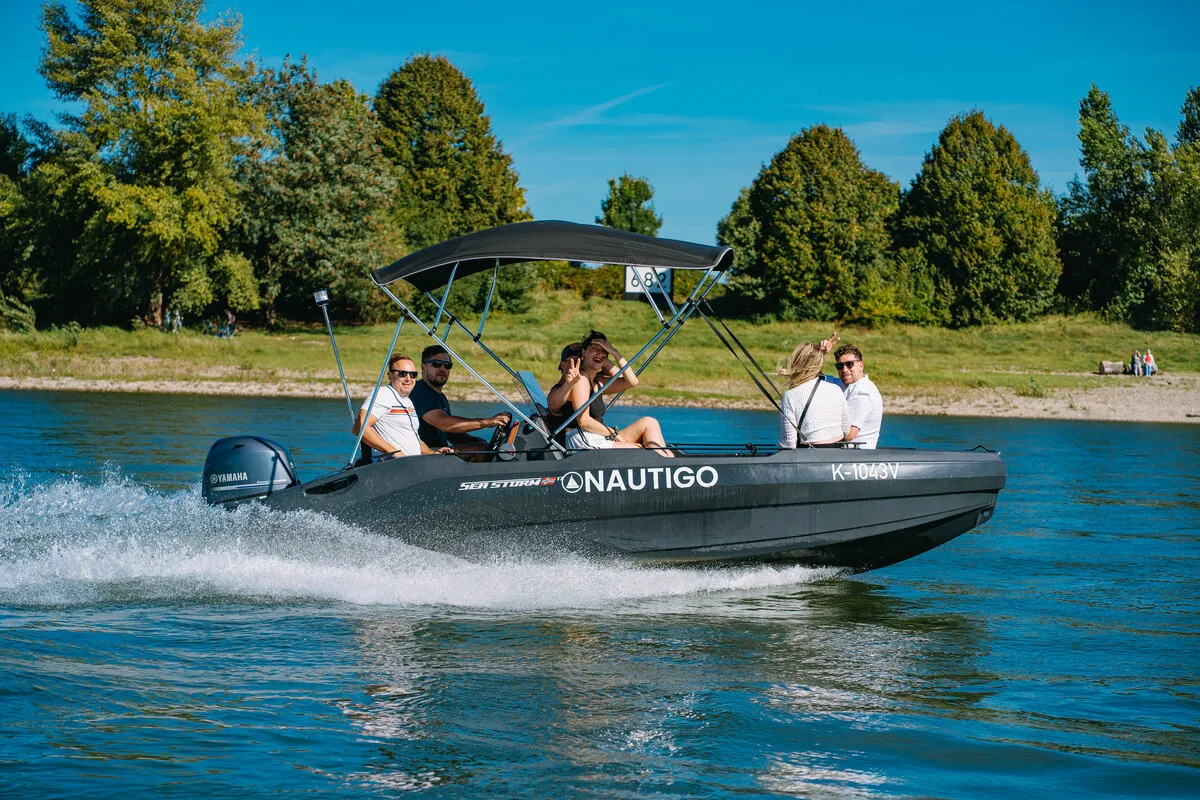
Modern four-stroke outboard engines are now the standard in recreational boating: smooth, clean and economical[4]. For the SeaStorm 17 we use Mercury FourStroke engines from 40 to 80 hp. For information on outboard maintenance, read our article ″Outboard Maintenance: Service Intervals and Costs″.
Licence: the 15-horsepower threshold
Engine power also determines licence requirements. Licensing rules vary by country and region. In Germany, for example, an official sport boat licence is required for combustion-engine boats over 11.03 kW (15 hp) on most navigable waters[2]. Since sensible motorization for a 5-metre boat typically well exceeds this threshold, you should plan to obtain a licence from the outset. Contact your national maritime authority for your specific requirements.
How to find the right power
- Define your use: relaxed cruising, family boating, full load, or water sports?
- Check the nameplate: what maximum power is permitted?
- Plan for reserve: choose somewhat more reserve for fully-laden trips rather than operating at the limit.
- Take the whole picture: consider purchase, fuel consumption and maintenance together; see also our Buying Guide.
You can explore the SeaStorm 17’s motorization options without obligation in our configurator and write to us with your requirements, we respond by text, without pressure.