
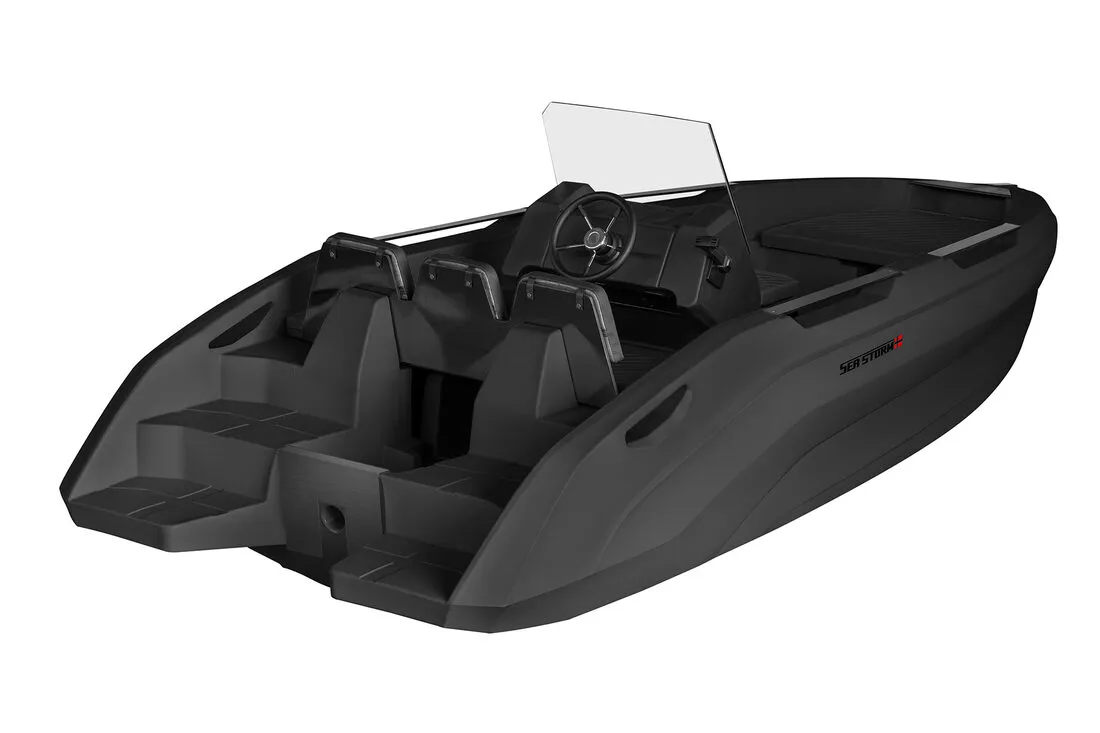
A HDPE boat (hull made of high-density polyethylene) is fundamentally a standard boat purchase, with a few material-specific considerations. This guide walks you through the decision without marketing superlatives and with honest ranges rather than false precision. If you want to clarify the material question first, read the detailed, sourced comparison “HDPE vs. GFK”.
What an HDPE boat brings to the purchase
Polyethylene is a thermoplastic: impact-resistant, corrosion-proof, and recyclable as a pure material [5] (though no widespread recycling route is yet established for end-of-life boats). In everyday boat operation, this typically means high tolerance to dock bumps, low maintenance demands (no gelcoat, no osmosis precautions), and robust performance in trailering and rental operations. The technical foundation is covered in the article “HDPE Boats: What Polyethylene Delivers”; for safety of twin-wall hulls, see “Twin-Wall Hull Explained”.
Importantly: “HDPE” is not a quality guarantee by itself. What matters is wall thickness, construction, and the certified design category per EU sports boat regulation [1]. So don’t buy the material, buy the boat.
The seven points that really matter in a purchase
- Design category and CE compliance. Every new sports boat carries CE marking and a design category A–D, which describes the permitted waters (wind/wave conditions) [1] [3]. Stability and buoyancy assessment follows EN ISO 12217 [2].
- Passenger capacity and payload. The nameplate states the maximum number of people and maximum load. Verify it matches your use (family, water sports, training).
- Engine power. From economical cruising to planing with reserve, the horsepower choice makes the difference. The article “How Much Horsepower Does My Motorboat Need?” addresses this.
- Delivery scope. “Turnkey” should mean: engine mounted and run-in, battery, fuel tank, controls, navigation light, and safety gear on board. Get the scope in writing.
- Trailer and transport. Lower hull weight eases trailering. Clarify trailer class, tongue weight, and required licence category (B/BE/B96).
- Service and spare parts. Who services the engine? Are parts available? A brand-name outboard with a dealer network simplifies maintenance.
- Total cost of ownership, not just purchase price. Insurance, mooring/storage, maintenance, and depreciation belong in the calculation, not just the sticker price.
Turnkey or self-build?
Many sellers market boats “ex-factory,” with ready-to-operate equipment as an add-on. A turnkey package bundles engine, pre-delivery inspection (PDI), fuel tank, battery, and basic gear into one price, that saves coordination and surprises. So compare ready-to-operate final states, not bare hull prices.
Realistic cost breakdown
Only ranges are reliable; final price depends on model, engine, and options:
| Cost category | Rough guideline | | --- | --- | | HDPE sports boat purchase, up to 17 ft | roughly 15,000–30,000 EUR depending on engine/options | | Engine power (upgrade spread) | several thousand EUR difference depending on HP class | | Trailer | varies by weight class and brake type | | Annual running costs | insurance, mooring/storage, maintenance, fuel |
Note: These ranges are guidelines, not an offer. Binding figures come only from your actual configuration. Current SeaStorm 17 pricing is available in the configurator.
Licensing and legal matters
The hull material changes nothing about obligations. Licence and registration requirements depend on your country and the boat’s engine power. In Germany, for example, the official sports boat licence is required for combustion-engine boats over 11.03 kW (15 HP) on most waterways. Check with your national competent authority (such as ELWIS in Germany) [4] for your jurisdiction. Your boat’s design category and what waters it covers appear in the conformity documents [1].
How to proceed
Start by sorting your use case (waters, passengers, intended use), then engine power, then delivery scope. If you like, configure the SeaStorm 17 without obligation and send us your requirements, we reply in writing, no sales pressure.