“Unsinkable” is a strong word, and for that very reason you should be sceptical when you hear it as a blanket promise. A double-hull HDPE hull can be described credibly in terms of three measurable factors: buoyancy, stability, and the assigned design category. This article explains what the construction delivers and where its limits lie.
What “double-hull” means in design terms
A double-hull consists of an outer and inner shell that enclose a sealed cavity. In HDPE boats, these shells are made from high-density polyethylene, a thermoplastic whose material specification is governed by ISO 1872-1 [5]. The advantage of the sandwich principle: the shell becomes stiffer, impacts are dampened, and the enclosed air volume provides additional buoyancy. More on material properties can be found in the article ” HDPE Boats: What Polyethylene Delivers”.
Buoyancy is not the same as “unsinkable”
Additional buoyancy increases residual buoyancy, the margin when water enters the cockpit. This is a genuine safety gain, but no free pass. The decisive assessment is made according to EN ISO 12217, which tests stability and buoyancy and results in a design category [2]. It is this category that tells you what wind and wave conditions the boat is designed for.
Stay honest: A double-hull structure improves the margin, but does not replace a life jacket, bailing capability, good judgment, and respecting the assigned category. “More safety” yes, “unsinkable under all circumstances” no.
Stability and design category
Design categories A through D per EU Recreational Craft Directive 2013/53/EU describe the permitted operating range [1] [4]:
| Category | Design (simplified) | | --- | --- | | A | Ocean, severe conditions | | B | beyond coastal waters | | C | coastal waters, large bays, rivers, lakes | | D | protected waters, small lakes, canals, rivers |
A compact recreational boat up to 17 feet is typically designed for coastal or protected waters. The specific category is stated on the nameplate and in the conformity documentation. The hull construction itself, wall thickness and dimensioning, follows EN ISO 12215 [3].
What this means in practice
- Docking and slips: A stiff, impact-resistant double shell tolerates minor knocks better, which pays off with frequent docking manoeuvres.
- Loading: Respect the crew numbers and cargo limits shown on the nameplate, because stability always depends on loading.
- Visual inspection: As with any boat, spot damage early. HDPE can be professionally welded, a different process from laminate repair in GFK. The comparison is explored in ” HDPE vs. GFK”.
Conclusion
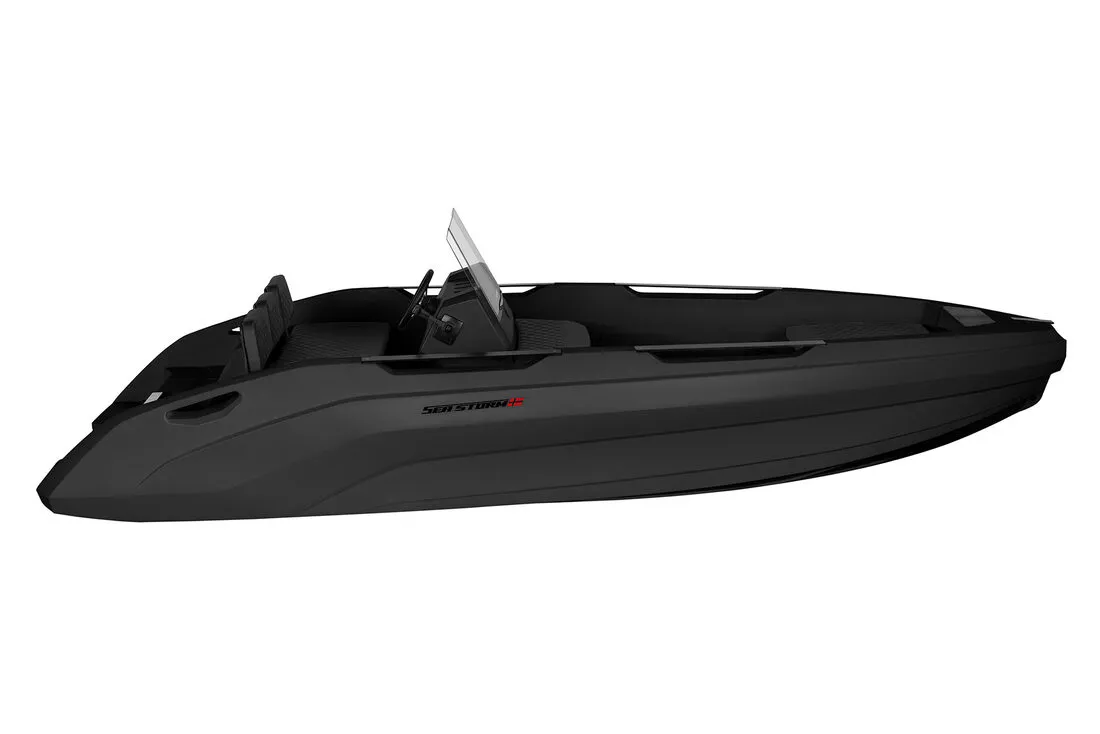
The double-hull HDPE hull is a tangible design advantage: greater stiffness, more buoyancy reserve, robust everyday performance. But the honest picture remains that safety emerges from the interplay of construction, design category, and behaviour on board. If you want to know which SeaStorm 17 configuration suits your waters, get in touch, or first check out the buying guide.